

Experience Revolear
Explore our demos, discover our technology, get a quote, and meet our team—human and AI—in our Virtual Briefing Center.

Ask a RevOps leader what percentage of deals should reach deal desk, and most will reach for a benchmark — some remembered number that sounds like an industry standard. It's the wrong instinct. The honest answer is that there isn't a stable industry-wide percentage, because the number isn't a fact about deal desks in general — it's a direct output of where a specific company sets its own approval thresholds. Move the threshold, and the percentage moves with it, on command.
The Problem. Leaders benchmark deal desk workload against an assumed industry-average percentage of deals that require review.
The Instinct That's Wrong. Treating "percentage of deals reaching deal desk" as a fixed fact to be discovered, rather than a policy variable the company itself controls.
The Fix. Set the mandatory-review threshold deliberately, watch how the resulting percentage moves, and use that percentage as a diagnostic of the threshold's calibration — not as a number to match against a supposed industry norm.
Two data points hold up under real scrutiny, and neither supports a single clean benchmark.
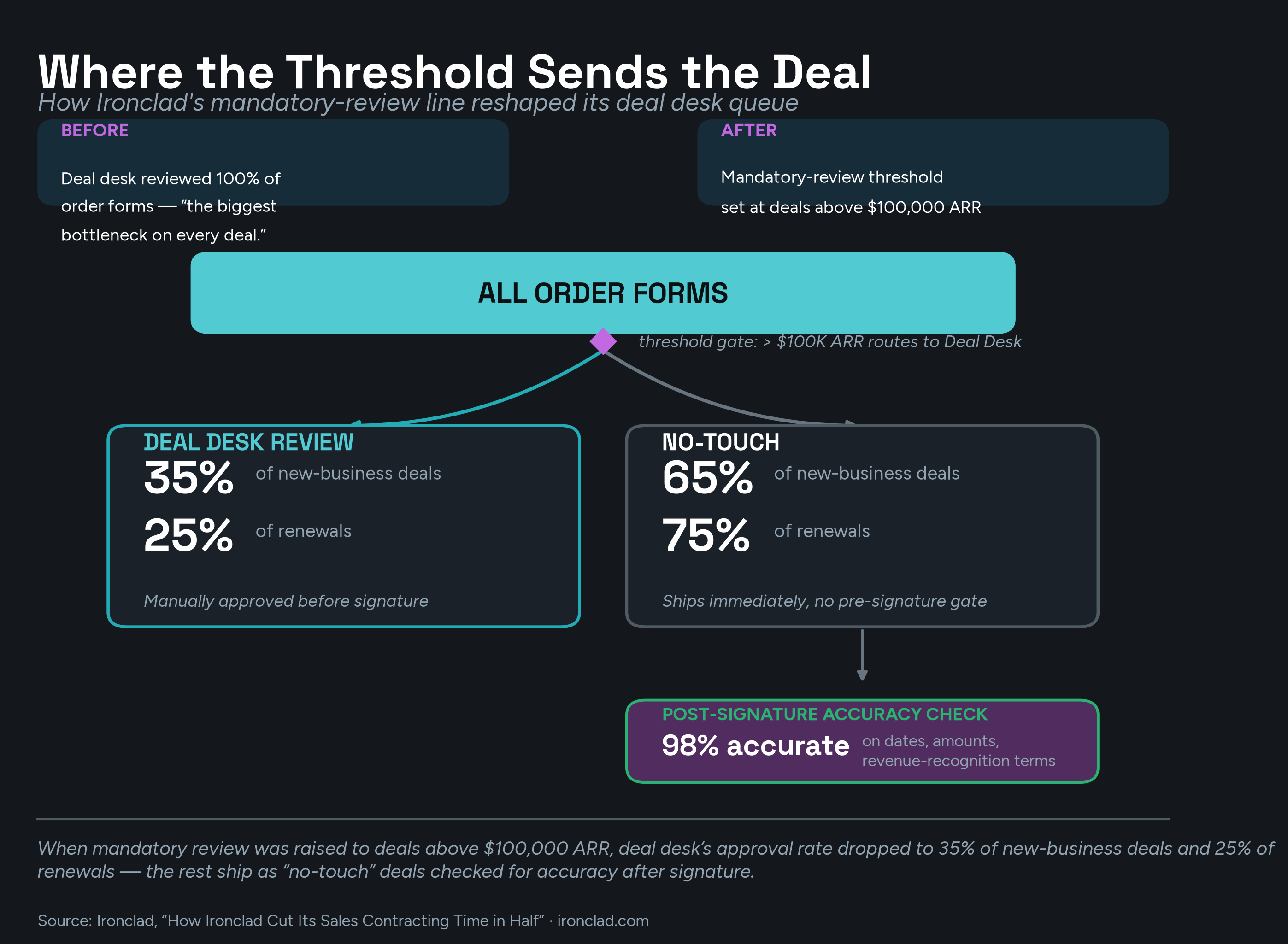
Put those together and the pattern is unambiguous: the percentage of deals reaching deal desk is not converging toward any single number across companies — it is a direct function of a threshold each company sets and can reset. A widely circulated claim that SalesGlobe, Ironclad, and Gartner data can be triangulated into one clean industry percentage does not hold up against the primary sources; no such figure exists in the material either company has published. Treat any number presented that way as UNVERIFIED and use the threshold logic below instead.
Ironclad's own experience is the most useful evidence here precisely because it's a before-and-after inside one company, not a cross-company average. Moving the mandatory-review line from "every deal" to "deals above $100K ARR" cut deal desk's touch rate from 100% to roughly a third of new business — and the company is moving that line again, to $250K ARR, presumably because the data from the first move told them the threshold still had room to rise without increasing risk. That is what a healthy calibration process looks like: set a threshold, measure the resulting percentage and the accuracy of what gets waved through, and adjust.
The post-signature accuracy check matters as much as the pre-signature threshold. Ironclad reported a 98% accuracy rate on its no-touch order forms — checking things like start and end dates and revenue-recognition amounts after the fact rather than gating every deal before it. That is the real safeguard against setting the threshold too high: a company doesn't need deal desk to touch every deal in advance if it has a reliable way to catch the small number of no-touch deals that turn out to need correction.
Revolear sets up dozens of new Order Forms every quarter for usage-based businesses and assists our customers' sellers in the mechanics of setting up these deals. Almost every customer asks us some version of "what should our threshold be" — and the honest answer is always the same one this post gives: there's no borrowed number that substitutes for watching your own approval-rate data as you move the line.
Stop looking for the industry-average percentage of deals that should reach deal desk — the number doesn't exist, and chasing it wastes the energy that should go into calibrating a company's own threshold. What does exist is real evidence that a deliberately set, periodically revisited threshold is the mechanism that determines the percentage, and that a well-designed no-touch accuracy check is what makes it safe to keep raising that threshold over time.
Related in this series: this post is part of Revolear's Deal Desk Handbook. Read more from the series:
What a Deal Desk Actually Does (and Why Most Companies Eventually Build One) — read the pillar post
The 10 Most Common Deal Desk Requests, and How to Evaluate Them — read the post
Building a Discount Approval Matrix: The Authority-Tiering Framework
The Deal Desk Glossary — read the capstone

Explore our demos, discover our technology, get a quote, and meet our team—human and AI—in our Virtual Briefing Center.
548 Market St, Suite 69725
San Francisco, CA 94104.

