

Experience Revolear
Explore our demos, discover our technology, get a quote, and meet our team—human and AI—in our Virtual Briefing Center.

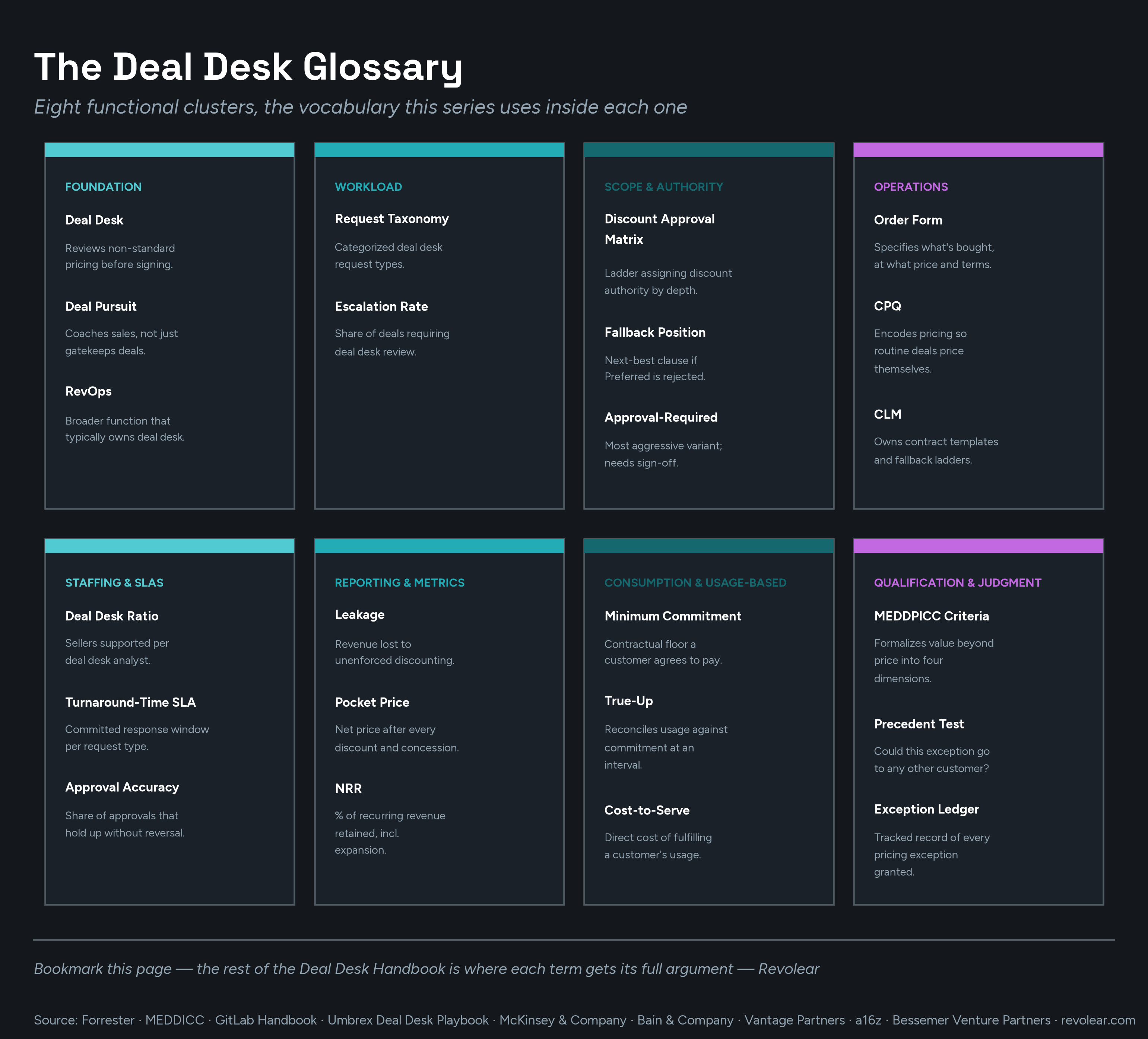
The Problem. Deal desk terminology is scattered across CPQ vendor docs, contract templates, and RevOps job postings, with no single place that defines the vocabulary consistently.
The Instinct That's Wrong. Assuming every company means the same thing by "escalation," "true-up," or "fallback position" — the words get reused across pricing, legal, and billing contexts with subtly different meanings.
The Fix. One reference page, organized by function, that defines every term this series uses the way Revolear's deal desk practice actually uses it — built to be the page you bookmark, not re-read the whole series to find a definition.
This glossary collects every term used across Revolear's Deal Desk Handbook, organized into the six functional clusters the series itself follows: what the function is, how much work reaches it, who has authority over what, how it runs day to day, what it reports, and how it exercises judgment. Where a definition ties to a specific data point or named source from elsewhere in the series, that source is cited inline.
Deal Desk. The cross-functional function — typically sitting at the intersection of sales, finance, and legal — that reviews non-standard pricing, deal structure, and contract terms before a deal is signed. Mature deal desks evolve beyond pure compliance review into strategic deal positioning, a progression Forrester formalizes as three levels: compliance, deal desk, and deal pursuit (see "Deal Pursuit" below), as covered in the Pillar post.
Deal Pursuit. The most mature of Forrester's three deal-management levels, in which the function moves beyond gatekeeping into actively "helping sales improve strategic deal positioning, win rates and deal velocity" (Forrester).
RevOps (Revenue Operations). The broader function that typically owns deal desk alongside sales operations, marketing operations, and customer success operations — responsible for the systems, process, and data that connect the revenue lifecycle end to end.
Request Taxonomy. The categorized list of request types a deal desk fields — commonly non-standard discount approval, custom payment terms, contract redlines, and order-form structuring, as detailed in the 10 Most Common Deal Desk Requests post.
Escalation Rate. The share of total sales opportunities that require deal desk review rather than closing on standard terms — the workload metric covered in What Percentage of Deals Actually Reach Deal Desk.
Discount Approval Matrix (Authority-Tiering Framework). A structured ladder that assigns discount-approval authority to specific roles at specific discount depths — rep, manager, deal desk, executive — so that routine discounts clear quickly and only genuine exceptions escalate, as built out in the Authority-Tiering Framework post.
Escalation Triage. The process of routing an incoming deal desk request to the correct authority tier or function (deal desk vs. legal vs. executive) based on its type and risk profile, rather than defaulting every non-standard request to the same reviewer.
Solution Space. The boundary of contract and pricing terms deal desk can approve on its own authority without routing to legal — as opposed to terms (indemnification, liability caps, IP assignment) that fall outside that space, covered in What Should Deal Desk Own vs. Route to Legal.
Fallback Position. The next-best acceptable version of a clause or term when a customer rejects the preferred (standard) version — the middle rung of the Preferred/Fallback/Approval-Required structure this series uses throughout.
Approval-Required. The most aggressive, least-standard version of a clause or discount, structured so it cannot be offered without internal legal or executive sign-off before a seller uses it.
Order Form. The commercial document — typically referencing a master services agreement or terms of service — that specifies what a customer is buying, at what price, on what term, and under what conditions; the primary artifact deal desk reviews and often drafts, per Should Deal Desk Draft the Order Form.
CPQ (Configure, Price, Quote). The software system that encodes an organization's pricing architecture — packages, eligibility, discount corridors, floors, and stacking rules — so that routine pricing is automated rather than negotiated deal-by-deal (Umbrex Deal Desk Playbook).
CLM (Contract Lifecycle Management). The system and process for owning contract templates, clause libraries, fallback ladders, and executed-agreement history — including deviation metadata (see below).
Deviation Metadata. Structured records of what clause family changed on a given contract, which fallback rung was used, and who approved it — the data that turns individual contract exceptions into an organizational learning loop rather than one-off paperwork (Umbrex Deal Desk Playbook).
Private Offer. A custom, negotiated pricing arrangement created and transacted through a cloud marketplace (AWS Marketplace, Google Cloud Marketplace), which deal desk typically owns end-to-end for enterprise deals routed through a partner channel.
Deal Desk Ratio. The number of sellers or account executives supported per deal desk analyst — a staffing benchmark that varies widely by company and level of automation, discussed in When Should a Growing Company Build a Deal Desk Function.
Turnaround-Time SLA. A committed response or resolution window for a deal desk request type — GitLab's public handbook, for example, targets a 6-business-hour first response and a 24-hour Opportunity Approval SLA (GitLab Handbook), as covered in What Turnaround-Time SLA Should Deal Desk Commit To.
Approval Accuracy. The percentage of deal desk approvals that hold up without later correction or reversal — one of the KPIs GitLab publishes in its own handbook alongside case resolution and SLA attainment (GitLab Handbook).
Leakage. Revenue lost to undocumented, unapproved, or unenforced discounting and pricing deviations — a top-three pricing opportunity area according to Bain's global private equity pricing research (Bain & Company), covered in What Deal Desk Should Report to the CFO and Board.
Pocket Price. The net price a company actually realizes on a deal after every discount, rebate, and concession is netted out — the metric McKinsey argues is worth reporting instead of headline list price (McKinsey & Company).
Dynamic Deal Scoring. A system that scores an in-progress deal against comparable historical deals — factoring in dozens of variables — to produce a real-time discount recommendation and flag deals that risk destroying value, per McKinsey's B2B pricing research (McKinsey & Company).
Profit Cube. A structured pricing-analytics build that lets a company monitor margin performance across product, customer, and channel dimensions — the tool behind Loparex's 25% EBITDA lift under CEO Simon Medley, per Bain's account (Bain & Company).
Net Revenue Retention (NRR). The percentage of recurring revenue retained from an existing customer cohort over a period, including expansion and net of churn and contraction — a key health metric for usage-based businesses, where it typically runs higher at smaller ARR bands and compresses as a company scales (Bessemer Venture Partners).
Minimum Commitment. The dollar or unit floor a customer contractually agrees to pay or consume over a term, regardless of actual usage — the anchor term in most usage-based order forms.
True-Up. A billing mechanic that reconciles actual usage against a customer's committed amount at a defined interval, charging the customer for any usage above the commitment.
True-Forward. The alternative to a true-up in which overage usage is rolled into the customer's commitment for the next period rather than billed immediately — a structure a16z documents as reducing renegotiation friction for the customer (a16z).
Draw-Down Schedule. The pace at which a customer's prepaid or committed credits are consumed against actual usage over the contract term.
Credit Rollover. A contract term specifying whether unused usage credits carry forward into the next billing period or expire — an area this series flags as commonly underspecified and worth explicit ownership between deal desk, product, and finance.
Overage. Usage that exceeds a customer's committed amount within a billing period, typically billed at a separate (often higher) unit rate specified in the order form.
Co-Term. Aligning a new product, add-on, or amendment's contract end date to an existing agreement's renewal date, so a customer has one consolidated renewal event instead of multiple staggered ones.
ELA (Enterprise License Agreement). A large-scale, typically multi-year commercial agreement that bundles usage or seat allowances at a fixed price, often used to simplify a customer's growing consumption into a predictable enterprise-wide commitment.
Cost-to-Serve. The direct cost — most critically cloud infrastructure and inference cost for AI products — of fulfilling a given customer's usage, which a16z's research finds can run to roughly half of cost of revenue for public software companies and which Bessemer finds compresses AI product gross margins to 50-60% versus 80-90% for traditional SaaS (a16z; Bessemer Venture Partners), covered in The Full Remit.
MEDDPICC Decision Criteria. The element of the MEDDIC/MEDDPICC enterprise sales qualification framework that formalizes non-price value into three dimensions — Technical, Economic, and Relationship — plus a dedicated Competition field in the extended methodology, tracing to PTC in 1996 (MEDDICC).
Precedent Test. The discipline of asking whether a proposed exception could be offered to any other customer under the same circumstances — if not, the exception should be reconsidered rather than granted (Forrester), covered in How Deal Desk Weighs Qualitative Factors Beyond Price.
Reference-ability. A customer's willingness to serve as a public reference, case study, or reviewer in exchange for preferential pricing — a legitimate qualitative trade only if the reference obligation is tracked and enforced (Forrester).
Exception Ledger. A tracked record of every pricing or contract exception granted — who approved it, for which customer, the stated reasoning, and its measured downstream impact — the governance mechanism Vantage Partners' research identifies as the antidote to exceptions quietly becoming the norm (Vantage Partners).
Land-and-Expand. A go-to-market motion in which a customer starts on a smaller initial contract chosen for fast time-to-value and strategic platform fit, with sellers compensated more heavily on subsequent expansion revenue than on the opening deal size (Mark Roberge, former CRO, HubSpot).
Revolear sets up dozens of new Order Forms every quarter for usage-based businesses and assists our customers' sellers in the mechanics of setting up these deals. This glossary is the terminology we actually use with our customers' deal desks, RevOps teams, and finance leaders — not a vendor's marketing vocabulary.
Vocabulary discipline is a small thing that compounds. A deal desk, RevOps team, and legal function that use "fallback position," "true-up," and "escalation" consistently spend less time re-explaining terms to each other and more time actually structuring the deal. Bookmark this page as the reference; the rest of the series is where each concept gets its full argument.
This glossary is the capstone of Revolear's Deal Desk Handbook. Read the full series:
What a Deal Desk Actually Does (and Why Most Companies Eventually Build One) — read the pillar post
Inside a Deal Desk: A Conversation With Todd Johns, Former Head of Deal Desk at Salesforce — read the interview
The 10 Most Common Deal Desk Requests (and How to Evaluate Them) — read the post
What Percentage of Deals Actually Reach Deal Desk? — read the post
Building a Discount Approval Matrix: The Authority-Tiering Framework — read the post
What Should Deal Desk Own vs. Route to Legal? — read the post
Should Deal Desk Draft the Order Form? — read the post
When Should a Growing Company Build a Deal Desk Function? — read the post
What Turnaround-Time SLA Should Deal Desk Commit To? — read the post
What Deal Desk Should Report to the CFO and Board — read the post
The Full Remit: What Else a Mature Deal Desk Owns — read the post
Should Deal Desk Coach Sales Managers, Not Just Approve Deals? — read the post
How Deal Desk Weighs Qualitative Factors Beyond Price — read the post

Explore our demos, discover our technology, get a quote, and meet our team—human and AI—in our Virtual Briefing Center.
548 Market St, Suite 69725
San Francisco, CA 94104.

