

Experience Revolear
Explore our demos, discover our technology, get a quote, and meet our team—human and AI—in our Virtual Briefing Center.

The Problem. Most descriptions of deal desk stop at "approves discounts and reviews order forms," which understates the function almost as soon as it scales past a handful of reps.
The Instinct That's Wrong. Treating deal desk as a queue that processes exceptions, rather than as the team that owns the systems, data, and governance rhythm those exceptions run through.
The Fix. A mature deal desk's remit extends into CPQ and CLM administration, pricing governance, renewal and channel structuring, sales enablement, competitive intelligence, and — for a usage-based business — the metering, billing, and cost-to-serve data that determine whether a deal is even profitable.
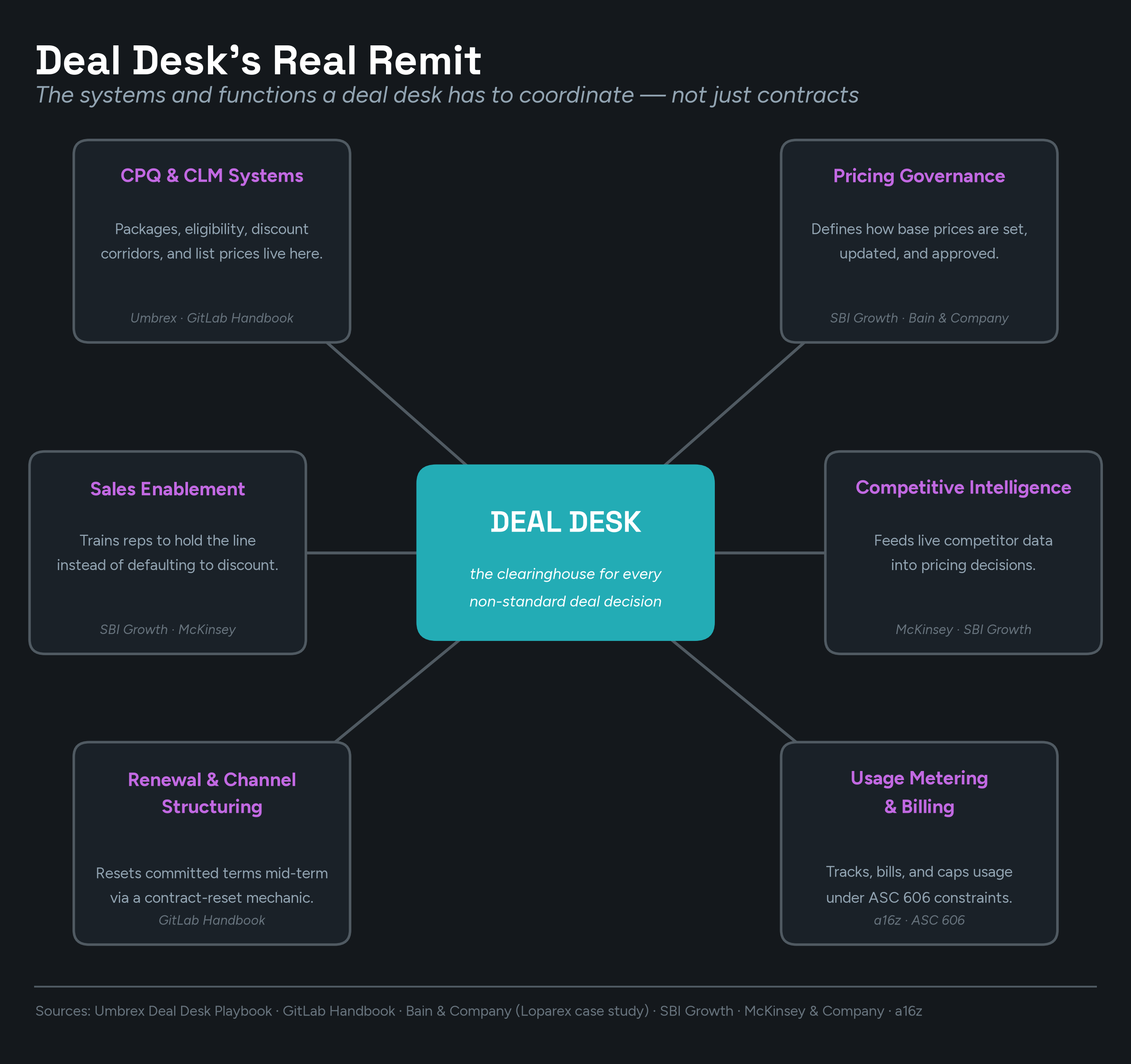
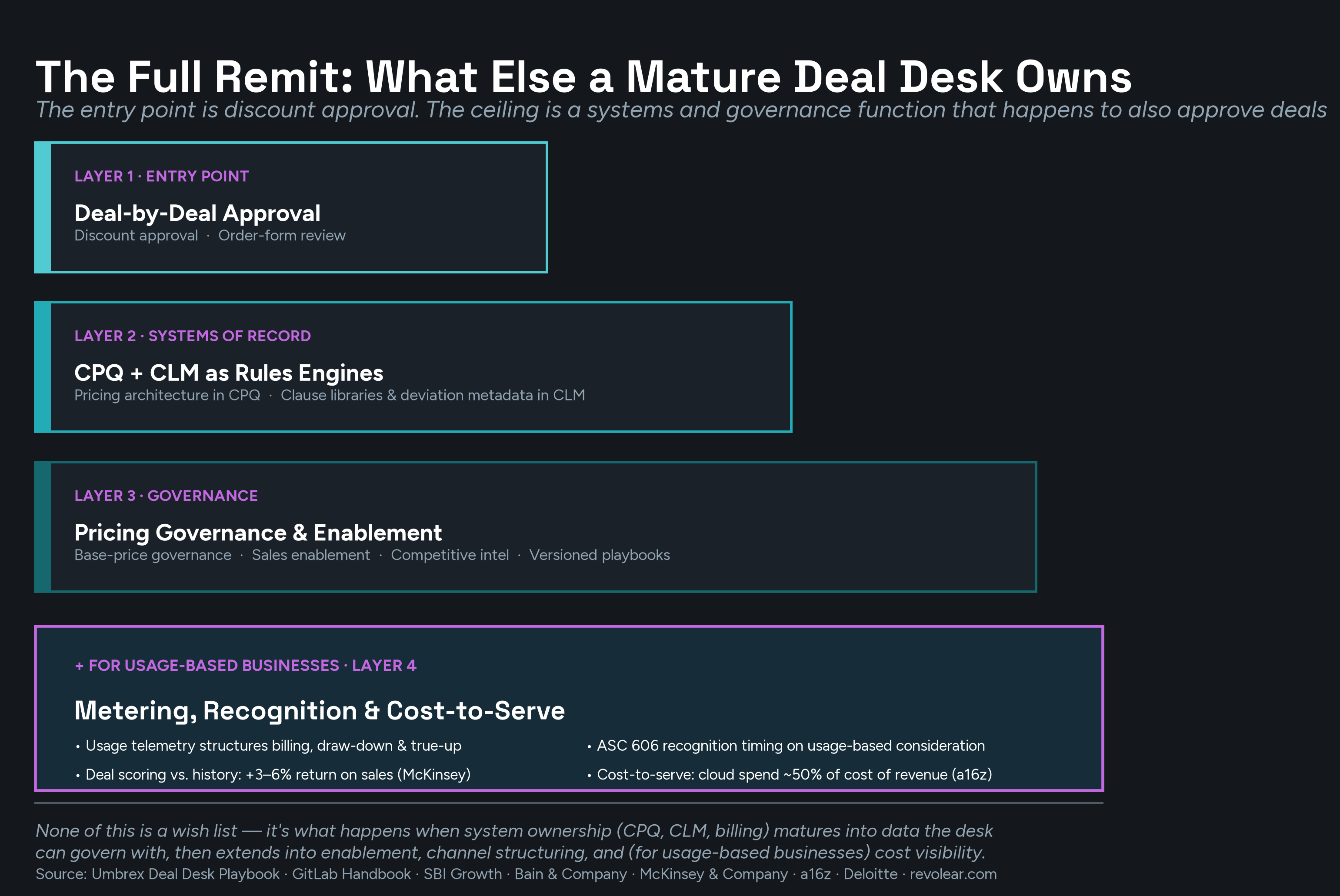
Ask ten RevOps leaders what deal desk owns and most will describe the same narrow slice: discount approvals, maybe order-form review. That's the entry point, not the ceiling. Once a desk has been running for a year or two, its actual remit tends to look like a systems and governance function that happens to also approve deals — and the evidence for that broader remit is unusually well documented, because one named public company, GitLab, publishes its entire deal desk operating handbook openly.
The first expansion is technical. A deal desk that treats CPQ as a calculator and handles every exception off-system stays a bottleneck by design; the alternative is encoding the pricing architecture directly into the tool — "packages and eligibility, permitted configurations, list prices, discount corridors, floors, stacking rules" (Umbrex Deal Desk Playbook). GitLab's own handbook confirms this runs in production at a NASDAQ-listed company: its deal desk "builds and validates complex quotes within SFDC/Zuora" and "audits quote approvals and workflow routing" (GitLab Handbook), and Bain's own Dynamic Deal Guidance tool is built to plug directly into "your existing CPQ (configure price quote) system... or a pricing tool such as Pricefx" (Bain & Company).
Contract lifecycle management extends the same logic to language instead of numbers. The desk, working with legal and contract ops, should own templates, clause libraries, and fallback ladders — but the real prize is structured deviation metadata: "what clause family changed, what fallback rung was used, and who approved it... that metadata is what turns contracting into learnings, not just throughput" (Umbrex Deal Desk Playbook). At GitLab this ownership extends to order-form language changes, non-standard payment terms, price-lock and future-pricing language, and "Contract Reset" — its term for the early-renewal mechanic that resets a customer's committed terms mid-term (GitLab Handbook).
Beyond systems, a mature desk becomes the operating arm of pricing governance itself. SBI Growth frames the mandate directly: governance "defines how base prices are established, updated, and approved," and without it, "sellers over-discount to win deals, creating margin leakage and precedent risk" (SBI Growth). Bain's account of Loparex, an Intermediate Capital Group portfolio company, shows what that governance looks like in practice under CEO Simon Medley: two full-time analysts to manage a "profit cube," a standing monthly leadership meeting to act on the data it produced, and leadership holding sellers accountable for concessions that caused leakage — the combined result was a 25% EBITDA lift (Bain & Company). None of that is deal-by-deal approval work; it's a standing analytics and accountability function that a deal desk is best positioned to run because it already sees every exception.
That governance role pulls in two more capabilities most job descriptions omit. First, sales enablement: SBI notes plainly that "discounts are often a symptom of weak negotiation. Without capability, reps give away margin" (SBI Growth), and McKinsey ties the strongest pricing performance to reps "empowered to adjust prices themselves rather than relying on a centralized team" once properly trained (McKinsey & Company). Second, competitive deal intelligence: McKinsey found "a third of executives thought their companies didn't systematically use competitive intelligence to review prices and develop offers" (McKinsey & Company) — a gap SBI's own survey suggests most companies have since closed, with 91% now folding some competitive intelligence into pricing decisions (SBI Growth). Playbook creation ties the two together: a versioned knowledge base written as decision trees — "what is standard, what is acceptable fallback, what needs escalation" — with a deliberate loop to promote recurring exceptions into new standard packages (Umbrex Deal Desk Playbook), justified by McKinsey's finding that roughly "75 percent of a typical company's revenue comes from its standard products" (McKinsey & Company) — the desk's real leverage is shrinking the 25% that isn't.
Consumption pricing adds an entire systems layer that a subscription-only deal desk never has to touch. Product usage and telemetry data become the raw material of both the price metric and the margin — a16z frames great product telemetry as what makes it possible to "track, bill, and even cap that usage" in the first place (a16z), and that same data has to structure credit draw-down, rollover, and true-up terms so that, as a16z puts it, "customers don't need to renegotiate their contracts in order to continue consuming" (a16z). Billing becomes a system of record the desk has to trust as much as the CRM, and revenue recognition adds a hard constraint on top: under ASC 606, usage-based royalty consideration can't be recognized until the later of the usage actually occurring and the performance obligation being satisfied, which means deal structures the desk signs off on — minimum guarantees, prepaid credits, back-loaded rates — directly change the company's recognition profile (Deloitte, Roadmap: Revenue Recognition).
Two more consumption-specific ownership areas round this out. Historical deal and win-loss databases feed real-time deal scoring against comparable peer sets — McKinsey's Dynamic Deal Scoring work cites a 3–6% increase in return on sales from exactly this kind of comparable-deal analysis (McKinsey & Company). And cost-to-serve visibility becomes non-negotiable: a16z's research on cloud economics found contractually committed cloud spend averaging roughly 50% of cost of revenue across public software companies (a16z), and Bessemer's AI Pricing Playbook puts AI-product gross margins at 50–60%, against 80–90% for traditional SaaS, precisely because "every AI query costs money" (Bessemer Venture Partners). A usage-based deal desk that only sees the deal's revenue line, and not its inference cost, is missing the number that decides whether the deal was worth signing.
Revolear sets up dozens of new Order Forms every quarter for usage-based businesses and assists our customers' sellers in the mechanics of setting up these deals. The desks that end up owning the widest remit aren't the ones that asked for more scope — they're the ones whose CPQ, CLM, and billing data were clean enough that governance, enablement, and cost visibility became a natural extension of work they were already doing.
The full remit isn't a wish list — it's what happens when a deal desk's system ownership (CPQ, CLM, billing) matures into data it can govern with (pricing analytics, deal scoring, competitive intelligence) and then extend into enablement and channel structuring. For a usage-based business, add metering, revenue-recognition timing, and cost-to-serve to that list, because none of the rest of the remit means much if the desk can't see whether a given deal is actually profitable.
Related in this series: this post is part of Revolear's Deal Desk Handbook. Read more from the series:
What a Deal Desk Actually Does (and Why Most Companies Eventually Build One) — read the pillar post
When Should a Growing Company Build a Deal Desk Function? — read the post
What Deal Desk Should Report to the CFO and Board — read the post
The Deal Desk Glossary — read the capstone

Explore our demos, discover our technology, get a quote, and meet our team—human and AI—in our Virtual Briefing Center.
548 Market St, Suite 69725
San Francisco, CA 94104.

