

Experience Revolear
Explore our demos, discover our technology, get a quote, and meet our team—human and AI—in our Virtual Briefing Center.

The Problem. Most deal desks are built and measured as an approval gate — a place where discounts and terms either clear or don't.
The Instinct That's Wrong. Treating deal desk as a compliance checkpoint means it only ever sees a deal after the negotiation is basically over, when there's nothing left to do but rubber-stamp it or block it.
The Fix. A mature deal desk moves upstream — coaching sales managers on the patterns in their team's discounting before those patterns become a quarter's worth of margin leakage, rather than approving or rejecting the last deal in isolation.
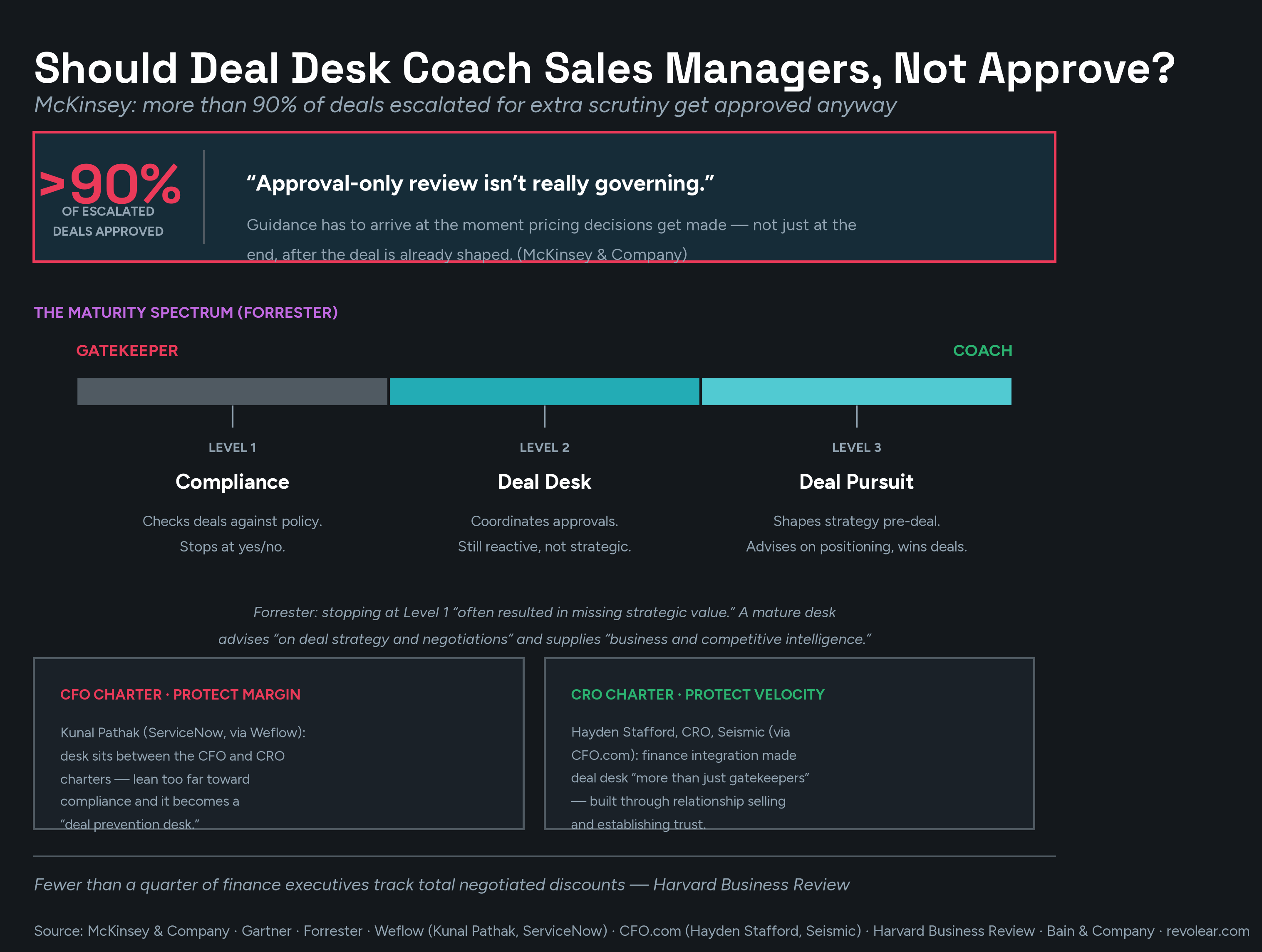
The uncomfortable data point behind this shift comes from McKinsey: more than 90 percent of deals escalated for extra scrutiny get approved anyway. If that's the base rate, a deal desk that only reviews deals one at a time isn't really governing anything — it's adding a step. The alternative McKinsey proposes is to move guidance earlier: "for pricing and discounting guidance to be effective, it needs to be given at the moment that pricing decisions are made, not just at the end of the process when a deal is being submitted for approval" (McKinsey & Company).
Where this gets interesting for deal desk design is who receives that earlier guidance. McKinsey's B2B pricing research is explicit that deal-scoring insight — the range of discounts on comparable deals, including what top-performing teams offered — should surface patterns that "help managers determine whether to change the terms or walk away" (McKinsey & Company). That's a management-level intervention, not a rep-level one — the desk isn't telling an individual seller what to quote, it's telling a sales manager that their team's discounting pattern is drifting and needs a conversation. Gartner's research on effective sales operations makes the same point from the systems side: "as sales operations expands its ability to guide sales leaders and sellers on key performance drivers and decisions... sales managers need better insight to effectively design and coach their teams" (Gartner).
Forrester's maturity model for deal management gives this shift a name. Forrester describes deal desks evolving through three levels — compliance, deal desk, and deal pursuit — and is blunt that stopping at the first level "often resulted in missing strategic value." The end state it describes is a desk that has "found a new niche — helping sales improve strategic deal positioning, win rates and deal velocity" (Forrester), which as the desk matures extends into advising "on deal strategy and negotiations" and supplying "business and competitive intelligence" (Forrester).
The clearest description of what this looks like operationally comes from a named practitioner rather than a top-tier research firm — a gap worth naming honestly. Kunal Pathak, Director of Deal Strategy & Operations at ServiceNow, frames the function as "a revenue enablement or a revenue accelerator function, and not a governance function," warning that it's "very easy for deal desk to become deal prevention desk" if it doesn't. His example of proactive coaching is concrete: reaching into a seller's pipeline before quarter-end to flag deals trending in the wrong direction — "I see you have ten deals in pipe, and these two are leaning towards a non-ideal direction. How can we get ahead of it?" (Kunal Pathak, ServiceNow, via Weflow).
Harvard Business Review's classic diagnosis explains why this pattern-level view is so often missing in the first place: "on a deal-by-deal basis, these discounts are given a lot of attention in the moment," but "there's little strategic thinking before the fact and seldom any examination of the pattern those individual decisions create after the fact." The same research found fewer than a quarter of finance executives even track total negotiated discounts, and almost none measure how those discounts distribute across segments and time (Harvard Business Review). That gap — no one owns the pattern — is exactly the seat a coaching-oriented deal desk fills.
Bain's B2B pricing survey of 1,704 companies supplies the closest thing to a rollout blueprint: dashboards that flag "places where sales reps might be getting too aggressive," regular reviews that catch where "frontline staff might game the system," and training salespeople on "how to have better pricing discussions" — paired with an executive who owns margin outcomes and reports on them (Bain & Company). One company in that survey designated an executive owner for margin opportunities and had the CEO demand pricing-action reporting from product and sales; the result was a 7-percentage-point EBITDA improvement (Bain & Company).
None of this resolves cleanly, and the sharpest disagreement in the evidence is worth stating plainly rather than papering over. Pathak frames deal desk as sitting between a CFO charter — protect margin, standardize discounting — and a CRO charter — protect velocity and scalability — and argues the desk has to honor both without becoming captured by either (Kunal Pathak, ServiceNow, via Weflow). Seismic's CRO and CFO describe getting there through relationship, not structure: CRO Hayden Stafford says finance's integration with sales made them "more than just gatekeepers," and that the way across that boundary is "relationship selling, establishing trust and building a genuine relationship" (CFO.com). There's no universal answer to which charter wins — only evidence that a desk which picks purely gatekeeping loses the trust it needs to coach anyone.
Revolear sets up dozens of new Order Forms every quarter for usage-based businesses and assists our customers' sellers in the mechanics of setting up these deals. The pattern we see most often: sales managers welcome pattern-level feedback on their team's discounting far more readily than they welcome a rejected order form, because the first feels like coaching and the second feels like a roadblock.
A deal desk that only approves or rejects the deal in front of it is, per McKinsey's own numbers, mostly rubber-stamping. The version that actually changes outcomes gives sales managers pattern-level visibility into their team's discounting before it becomes a trend, and it does that through relationship and shared data — not through a stricter gate.
Related in this series: this post is part of Revolear's Deal Desk Handbook. Read more from the series:
What a Deal Desk Actually Does (and Why Most Companies Eventually Build One) — read the pillar post
Building a Discount Approval Matrix: The Authority-Tiering Framework — read the post
How Deal Desk Weighs Qualitative Factors Beyond Price — read the post
The Deal Desk Glossary — read the capstone

Explore our demos, discover our technology, get a quote, and meet our team—human and AI—in our Virtual Briefing Center.
548 Market St, Suite 69725
San Francisco, CA 94104.

