

Experience Revolear
Explore our demos, discover our technology, get a quote, and meet our team—human and AI—in our Virtual Briefing Center.

We closed the last post in this series with a promise: a breakdown of the request types that actually land on a deal desk's desk, and how to evaluate each one. Pull the ticket queue at almost any company with a functioning deal desk, and the same small set of categories keeps reappearing — not because every business is identical, but because the same handful of commercial tensions (discount vs. margin, flexibility vs. risk, speed vs. precedent) recur in every sales motion. Here are the ten most common, in the order they typically show up in a rep's day.
The Problem. Reps and deal desk analysts often treat every non-standard request as a novel judgment call, re-litigating the same handful of question types from scratch each time.
The Instinct That's Wrong. Assuming every deal desk ticket needs bespoke reasoning rather than a repeatable evaluation checklist.
The Fix. A defined taxonomy of the recurring request types, each with its own short list of what to actually check before answering — so evaluation gets faster and more consistent as volume grows.
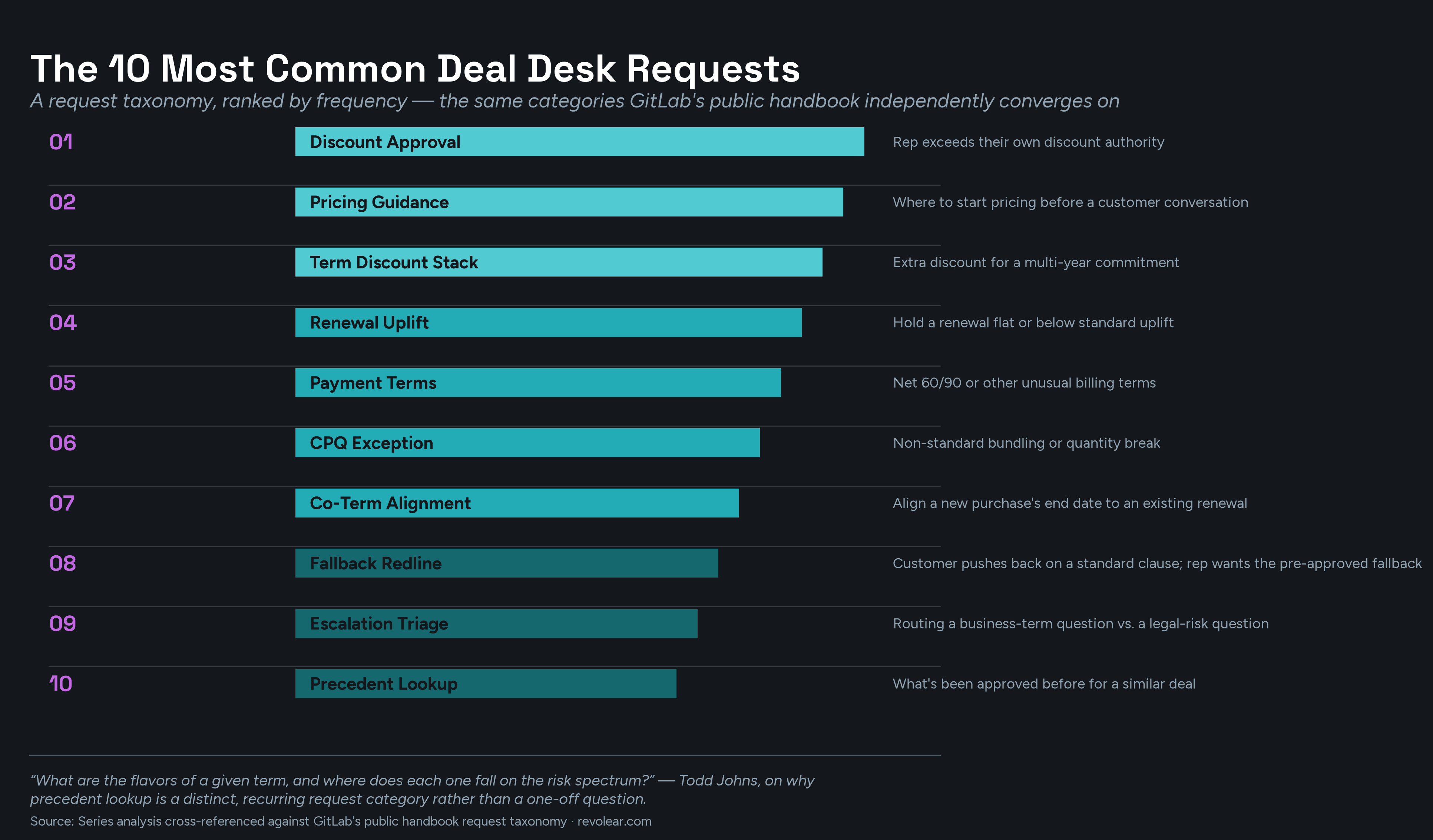
Revolear maintains a working taxonomy of deal desk requests across our customer base, and the pattern holds up against outside evidence. GitLab's public deal desk handbook — one of the few companies that publishes its process in the open — organizes its own case queue around nearly the same categories: discount and non-standard-deal-element approvals, deferred payments, price locks, contract resets and co-terms, flat renewals, and RFP support, each with its own service-level target. That two independently built taxonomies converge on the same short list is itself evidence that these ten categories aren't Revolear-specific — they're structural to how B2B sales organizations generate exceptions.
Notice what the list does not contain: nothing here requires deal desk to have an opinion about the customer's business, the competitive situation, or whether the deal is strategically worth doing. That's deliberate. Forrester's Steve Silver frames deal desk's baseline mandate as "reviewing and approving pricing and deal structure" — every item above sits inside that mandate. The moment a request stops being about discount, structure, or precedent and starts being about legal exposure or account strategy, it has left this list and belongs somewhere else in the org.
Revolear sets up dozens of new Order Forms every quarter for usage-based businesses and assists our customers' sellers in the mechanics of setting up these deals. This taxonomy is the same one we use internally to route and evaluate requests across our customer base — the categories above are drawn directly from that working list.
A deal desk that treats every ticket as a fresh judgment call will always feel slower and more arbitrary than one that recognizes the ticket as an instance of a known category. Ten categories cover the overwhelming majority of what actually shows up — discount and pricing questions, contract-structure exceptions, and process-routing decisions. Build the evaluation checklist once per category, and most of what looked like discretionary judgment turns out to be a fast, repeatable lookup.
Related in this series: this post is part of Revolear's Deal Desk Handbook. Read more from the series:
What a Deal Desk Actually Does (and Why Most Companies Eventually Build One) — read the pillar post
What Percentage of Deals Actually Reach Deal Desk? — read the post
What Should Deal Desk Own vs. Route to Legal?
The Deal Desk Glossary — read the capstone

Explore our demos, discover our technology, get a quote, and meet our team—human and AI—in our Virtual Briefing Center.
548 Market St, Suite 69725
San Francisco, CA 94104.

