

Experience Revolear
Explore our demos, discover our technology, get a quote, and meet our team—human and AI—in our Virtual Briefing Center.

The Problem. Most companies decide to build a deal desk only after something painful forces the question — a botched contract, an executive escalation, a quarter of margin leakage nobody can fully explain.
The Instinct That's Wrong. Assuming there's a universal revenue or headcount milestone — "$50M ARR" or "50 reps" — at which every company should build the function.
The Fix. The real trigger isn't a calendar date or a size threshold. It's deal volume, non-standard-term frequency, and discount depth crossing the point where handling exceptions ad hoc costs more than a dedicated function would.
Founders and revenue leaders ask this question constantly, and the honest answer disappoints most of them: there is no clean size at which a deal desk becomes mandatory. The data that exists points somewhere more useful — toward the mechanics that actually determine whether a company needs the function yet, and how big it needs to be once it does.
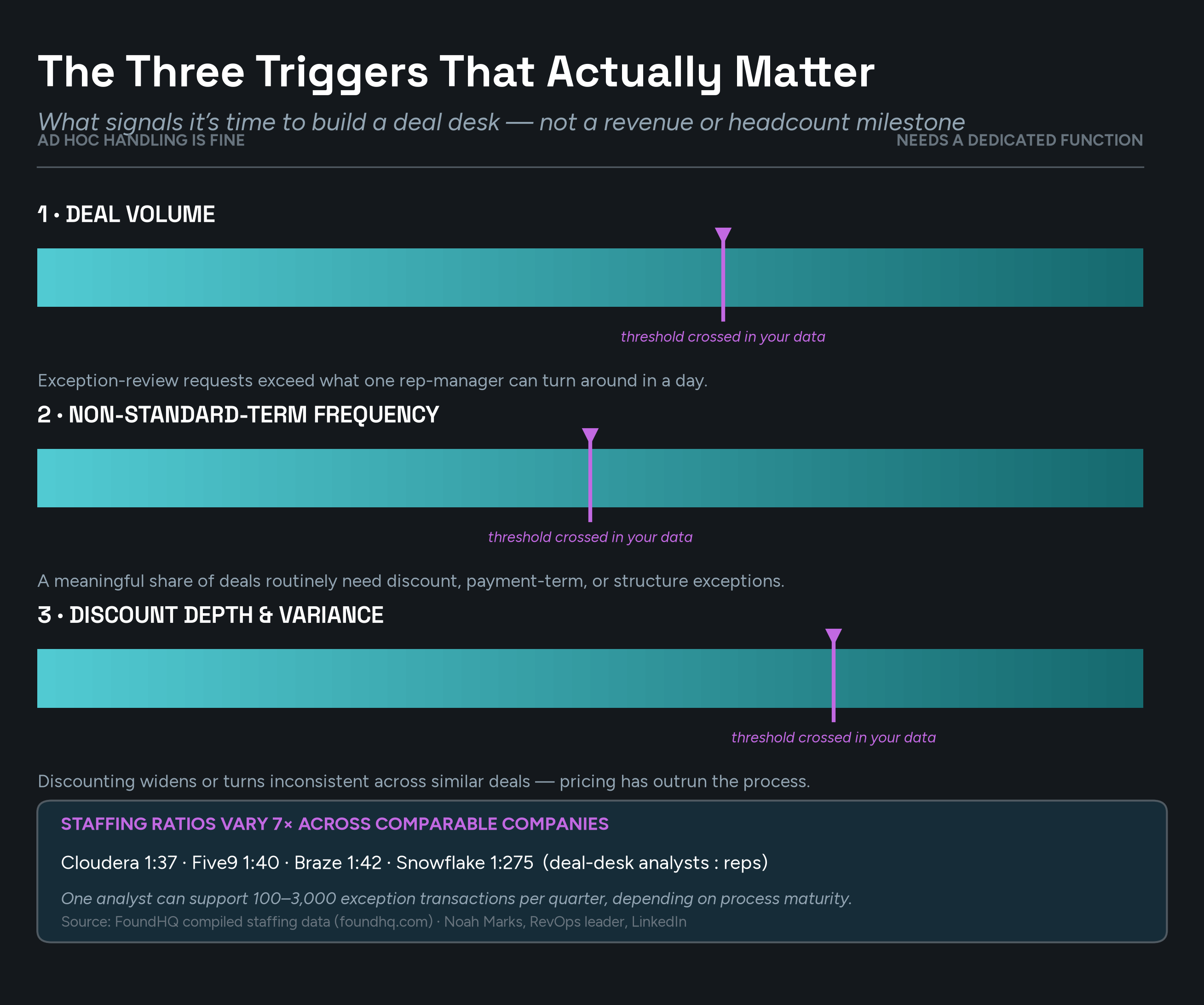
The clearest evidence against a fixed trigger comes from named public companies compiled by FoundHQ: Cloudera runs 16 deal desk analysts against 600 reps (roughly 1:37), Five9 runs 15 against 600 (roughly 1:40), and Braze runs 14 against 585 (roughly 1:42) — all in a similar band. Snowflake, by contrast, runs just 8 analysts against more than 2,200 reps, a ratio of roughly 1:275. Same function, same rough company size class, a sevenfold spread in staffing intensity. Max Maeder, founder of FoundHQ, has argued directly that the tight end of this range signals inefficiency rather than rigor: "It's true that 1 Deal Desk Analyst per 27 Reps is an unnecessary expense. To me, that's a cost center" (Max Maeder, LinkedIn). Snowflake's leaner ratio isn't evidence it under-invests in deal support — it's evidence that CPQ automation and clean rules absorb the volume a less-automated company would otherwise need headcount to cover.
That reframes the build question entirely. It isn't "are we big enough yet," it's "is our exception volume outrunning our current process, automated or not."
Independent research on the wider revenue-operations layer — of which deal desk is one slice — converges on a tighter band than the named-company spread suggests. Alexander Group's "Rule of Five" work sets a target of 10 core field sellers per revenue-operations resource, tied to measurable outcomes: companies hitting that ratio see a 23% lower expense-to-revenue ratio, 31% higher year-over-year revenue growth, and a 17% higher share of revenue from new customers. Alexander Group's separate 2024 research narrows that further for software specifically, putting XaaS companies at roughly 8.7 sellers per sales-operations resource, versus 12.9 in manufacturing and 13.9 in healthcare — software runs a denser support layer than most industries, not a leaner one.
McKinsey's research on sales-support design reinforces the same direction: the highest-performing sales organizations devote 50–60% of sales headcount to support functions, carry roughly double the share of operations and administrative support that average performers do (27% versus 12%), and run a nonmanager-to-manager ratio near 8:1. Two independent surveys land in the same neighborhood — SellingBrew's SalesPulse data puts sales-ops staffing at one person per 10 to 15 salespeople, and PeerSignal's dataset of 7,700 revenue-operations professionals supporting 91,000 sellers works out to roughly 12:1. None of these numbers is deal-desk-specific — they cover the whole operations layer — but they establish a real, sourced range (roughly 1 ops resource per 9 to 13 sellers) that deal desk sits inside as a sub-function, meaning the deal-desk-only ratio will run looser than these totals.
Noah Marks, a RevOps leader who has written on scaling operations ratios, offers a more direct sizing method: measure the transactions themselves. "Deal Desk (deal strategy) and Deal Admin (deal processing) can scale dramatically if the right processes and technologies are there to support them. I've seen these teams support anywhere from 100 to 3,000 transactions each per quarter" (Noah Marks, LinkedIn). That 30x range makes the same point as the Cloudera-to-Snowflake spread from a different angle: transaction volume and process maturity, not rep count, set the ceiling on what one analyst can handle.
Put the evidence together and three measurable triggers replace the mythical revenue milestone:
None of these triggers has a fixed threshold that applies to every company — that's the point. A usage-based business with complex overage and true-up mechanics will hit the non-standard-term trigger earlier, at lower revenue, than a company selling a single-SKU subscription. The trigger is the pattern in your own data, not a number borrowed from someone else's.
Revolear sets up dozens of new Order Forms every quarter for usage-based businesses and assists our customers' sellers in the mechanics of setting up these deals. The companies that come to us earliest aren't the biggest — they're the ones where non-standard usage terms (credit rollover, true-ups, overage handling) hit deal volume before headcount ever did.
Stop waiting for a revenue milestone to justify building a deal desk. The named-company data shows staffing intensity varies sevenfold at similar company sizes, and the ops-layer research shows the strongest performers invest more in support functions, not less. Watch deal volume, non-standard-term frequency, and discount variance in your own pipeline — those three signals will tell you when ad hoc handling has started costing more than a dedicated function would, well before any arbitrary size threshold does.
Related in this series: this post is part of Revolear's Deal Desk Handbook. Read more from the series:
What a Deal Desk Actually Does (and Why Most Companies Eventually Build One) — read the pillar post
Building a Discount Approval Matrix: The Authority-Tiering Framework — read the post
What Turnaround-Time SLA Should Deal Desk Commit To? — read the post
The Full Remit: What Else a Mature Deal Desk Owns — read the post
The Deal Desk Glossary — read the capstone

Explore our demos, discover our technology, get a quote, and meet our team—human and AI—in our Virtual Briefing Center.
548 Market St, Suite 69725
San Francisco, CA 94104.

