

Experience Revolear
Explore our demos, discover our technology, get a quote, and meet our team—human and AI—in our Virtual Briefing Center.

Ask a deal desk analyst and a contracts lawyer to define "deal desk scope" independently, and you'll usually get two different, defensible answers — because the honest answer is that scope is a governance question, not a technical one. The clearest published frameworks agree on more than most people expect: deal desk owns the commercial economics of a deal, Legal owns the risk embedded in its terms, and the two functions are supposed to move in parallel, not in sequence.
The Problem. When deal desk and Legal scope isn't defined in advance, every non-standard request becomes its own negotiation over who gets to decide.
The Instinct That's Wrong. Treating "commercial" and "legal" as a hard line item by item, rather than a split between economic terms (deal desk's lane) and risk-bearing terms (Legal's lane).
The Fix. A published delegated-authority matrix, with an explicit list of terms that are never delegable to deal desk regardless of deal size.
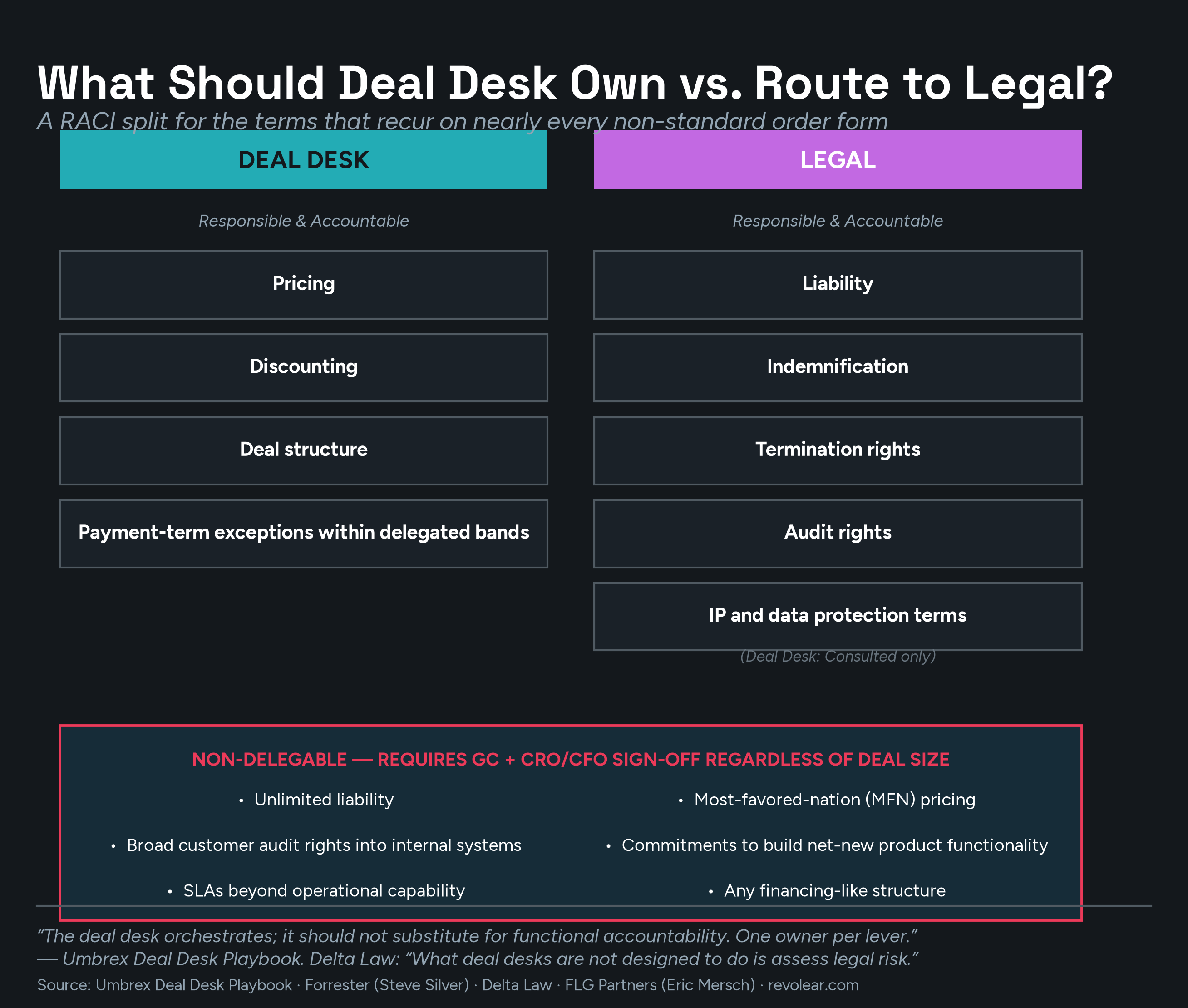
Independently, the sources on this question converge on the same split.
The clearest, most operational answer comes from Umbrex, which publishes an explicit non-delegable list: terms that require General Counsel and executive sign-off no matter the deal size — "unlimited liability, most-favored-nation pricing, broad customer audit rights into sensitive systems, commitments to build net-new product functionality, SLAs beyond operational capability, and any structure that shifts your business from selling software to providing financing-like terms" (Umbrex). Everything on that list is a risk term. Deal desk's own charter, by contrast, explicitly excludes legal advice: "Not in scope: legal advice or acting as a substitute for counsel; the desk uses playbooks but does not practice law" (Umbrex).
The three variants below describe alternative levels of formality for the same governance document — a deal desk charter's ownership-of-terms section — not three different charters.
Preferred: Explicit RACI With a Non-Delegable List
Deal Desk is Responsible and Accountable for pricing, discounting, deal structure, and payment-term exceptions within delegated bands. Legal is Responsible and Accountable for liability, indemnification, termination rights, audit rights, intellectual property, and data protection terms; Deal Desk is Consulted, not Accountable, on these terms. The following terms are non-delegable and require General Counsel and [CRO/CFO] sign-off regardless of deal size: unlimited liability, most-favored-nation pricing, broad customer audit rights into [Company]'s internal systems, commitments to build net-new product functionality, service levels beyond current operational capability, and any structure that functions as customer financing. Requests that touch both an economic term and a non-delegable term route to Deal Desk and Legal in parallel, not in sequence.
Use this when: the company has enough deal volume and precedent to define term-level ownership precisely — the model Umbrex documents in the most complete form currently published.
Fallback: Two-Bucket Split Without a Formal RACI
Deal Desk owns and may approve, within its delegated authority, all terms relating to price, discount, and payment timing. Any request to modify liability, indemnification, termination, audit rights, or data protection terms is routed to Legal for review before Deal Desk finalizes the commercial terms of the quote. Deal Desk does not independently approve or draft legal risk language under any circumstance.
Use this when: the company is too early to have a documented non-delegable list, but still needs a bright line between commercial and legal terms — consistent with Forrester's baseline mandate and Delta Law's warning that deal desks fail without this line drawn clearly.
Approval-Required: Legal Reviews Every Non-Standard Request
Any deviation from the standard order form template — commercial or legal — requires Legal review and sign-off before the quote may be issued to the customer. Deal Desk may recommend a structure but does not have independent authority to finalize any non-standard term.
Use this when: the company has no deal desk function yet, or Legal has not yet had the bandwidth to define fallback positions and thresholds that let Deal Desk operate independently — Delta Law's point that "deal desks need legal leadership, not just documentation" applies most directly here.
One gap is worth naming rather than papering over: no tier a/b/c source we could locate directly addresses who owns usage-credit rollover and expiration terms — a question that matters enormously for consumption-priced businesses. Umbrex's framework covers "usage commitments and true-ups" as a structural trigger requiring cross-functional routing, but does not assign rollover/expiration ownership specifically to deal desk, product, or finance. Treat that particular question as open until a named practitioner source addresses it directly.
Revolear sets up dozens of new Order Forms every quarter for usage-based businesses and assists our customers' sellers in the mechanics of setting up these deals. The RACI ambiguity above — who owns a term when it touches both pricing and risk — is the single most common escalation we see slow down a signature.
The frameworks that have actually been published agree more than the folklore suggests: deal desk owns economics, Legal owns risk, and the two should move in parallel rather than waiting on each other. The value of writing this down explicitly — including the terms that are never delegable — isn't bureaucratic. It's what lets deal desk move fast on the 90%+ of deals that don't touch a non-delegable term, without ever creating the appearance that it quietly approved something that needed a lawyer's sign-off.
Related in this series: this post is part of Revolear's Deal Desk Handbook. Read more from the series:
What a Deal Desk Actually Does (and Why Most Companies Eventually Build One) — read the pillar post
Building a Discount Approval Matrix: The Authority-Tiering Framework
Should Deal Desk Draft the Order Form?
The Deal Desk Glossary — read the capstone

Explore our demos, discover our technology, get a quote, and meet our team—human and AI—in our Virtual Briefing Center.
548 Market St, Suite 69725
San Francisco, CA 94104.

