

Experience Revolear
Explore our demos, discover our technology, get a quote, and meet our team—human and AI—in our Virtual Briefing Center.

Every RevOps leader has heard some version of the joke: "deal desk" is really the "deal prevention desk." It is a fair jab at bad implementations, but it gets the diagnosis backward. The friction sales reps feel is real — but the research says it is caused by unstructured internal process, not by the existence of a formal review function. Reps who complain about deal desk are usually complaining about ad hoc escalation dressed up as a process. The fix for that is a better-designed deal desk, not no deal desk at all.
The Problem. As deal volume and deal complexity grow, informal escalation — a Slack DM to a sales VP, a side deal nobody logs — breaks down, and internal friction becomes the single largest self-inflicted drag on the sales cycle.
The Instinct That's Wrong. Treating a deal desk as a gatekeeping function whose job is to slow reps down and say no to discounts.
The Fix. A deal desk formalizes decisions that are already happening informally — reviewing pricing, deal structure, and non-standard terms against a defined set of guardrails — and structured review measurably shortens cycles rather than lengthening them.
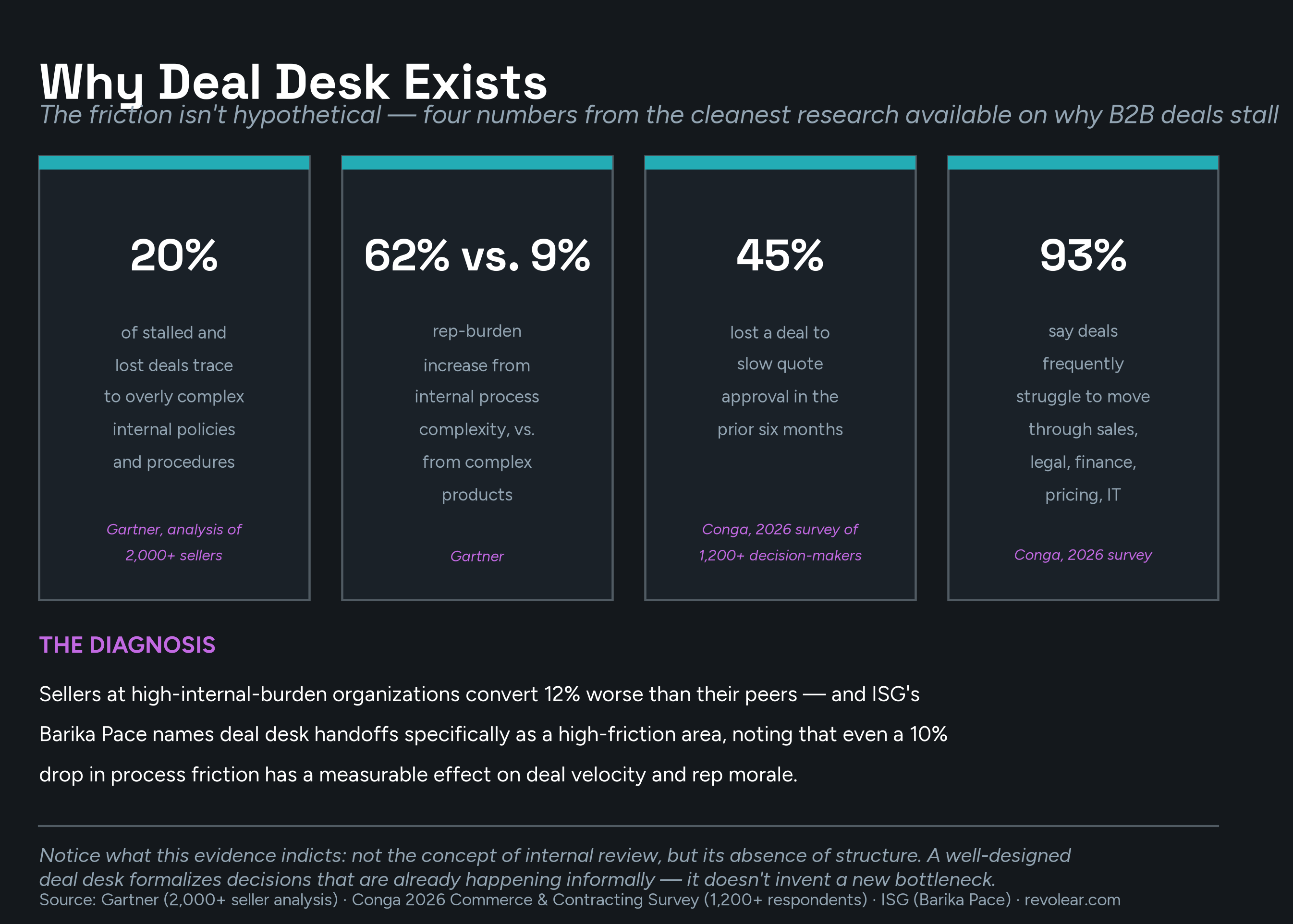
The case for a deal desk does not rest on intuition. It rests on some of the cleanest research available on why B2B deals actually stall.
Notice what this evidence actually indicts: not the concept of internal review, but its absence of structure. Deals stall when approval paths are unclear, undocumented, or invented on the fly — exactly the conditions a well-designed deal desk exists to remove.
Revolear defines a deal desk the same way Forrester analyst Steve Silver does at its most basic level: a function "responsible for reviewing and approving pricing and deal structure, ensuring compliance with price structure, profitability and solution components." As a desk matures, Silver notes, it typically adds capacity for RFP responses and deal-strategy advice. That mandate is narrower than most people assume — it is about commercial economics, not legal risk, and about applying pre-agreed guardrails, not inventing new rules deal by deal.
Early-stage companies do not need one. A founder and a handful of reps can informally agree on what discount is acceptable over lunch. That model breaks the moment deal volume and non-standard-term requests outgrow what one or two people can track in their heads. At that inflection point, the informal escalation that used to work quietly starts producing exactly the symptoms Gartner and Conga measured above: reps guessing at what will get approved, managers rubber-stamping requests they don't have time to evaluate, deals sitting in inboxes because nobody owns the decision. A deal desk is the structural answer — not a new layer of bureaucracy, but a replacement for the informal layer that already stopped working.
In practice, requests cluster into a small number of recurring categories — discount approval, pricing guidance, payment-term exceptions, co-term alignment, renewal uplift, and CPQ configuration exceptions among them. We break down the ten most common request types, and how to evaluate each, in the next post in this series (link on publish).
Revolear sets up dozens of new Order Forms every quarter for usage-based businesses and assists our customers' sellers in the mechanics of setting up these deals. The pattern above — informal escalation collapsing under deal volume — is the single most common reason a company first reaches out to us.
The evidence points to a specific, narrow conclusion: internal complexity, not customer or product complexity, is the largest self-inflicted tax on the sales cycle, and unstructured internal review is what actually produces the friction reps resent. A deal desk, properly scoped, is the fix for that — a function that owns pricing and deal-structure decisions against defined guardrails, so the guesswork Gartner and Conga measured has somewhere real to go. Everything else in this series — how to build the authority ladder, where the line with Legal sits, when to formalize the function, what to report upward — is an elaboration of that one idea.
Related in this series: this post is the foundation of Revolear's Deal Desk Handbook. Read more from the series:
Inside a Deal Desk: A Conversation With Todd Johns, Former Head of Deal Desk at Salesforce — read the interview
The 10 Most Common Deal Desk Requests, and How to Evaluate Them — read the post
Building a Discount Approval Matrix: The Authority-Tiering Framework
The Deal Desk Glossary — read the capstone

Explore our demos, discover our technology, get a quote, and meet our team—human and AI—in our Virtual Briefing Center.
548 Market St, Suite 69725
San Francisco, CA 94104.

