

Experience Revolear
Explore our demos, discover our technology, get a quote, and meet our team—human and AI—in our Virtual Briefing Center.

Ask who actually types the order form, and you'll get answers that sound contradictory until you notice they're describing different deal sizes. For a standard renewal, the honest answer is often "nobody" — a CPQ tool generates it the moment a rep finalizes a quote. For a complex, non-standard deal, the honest answer converges across every source we could verify: deal desk drafts it, and Legal reviews rather than originates it.
The Problem. Order-form drafting gets treated as an all-or-nothing question — either sales reps write every contract from scratch, or Legal has to touch every deal before it goes out.
The Instinct That's Wrong. Assuming order-form drafting is inherently a legal task rather than a templated commercial one.
The Fix. Standard deals flow through CPQ automation; deal desk owns preparation and quality control on everything else, with Legal reviewing only the terms that actually carry legal risk.
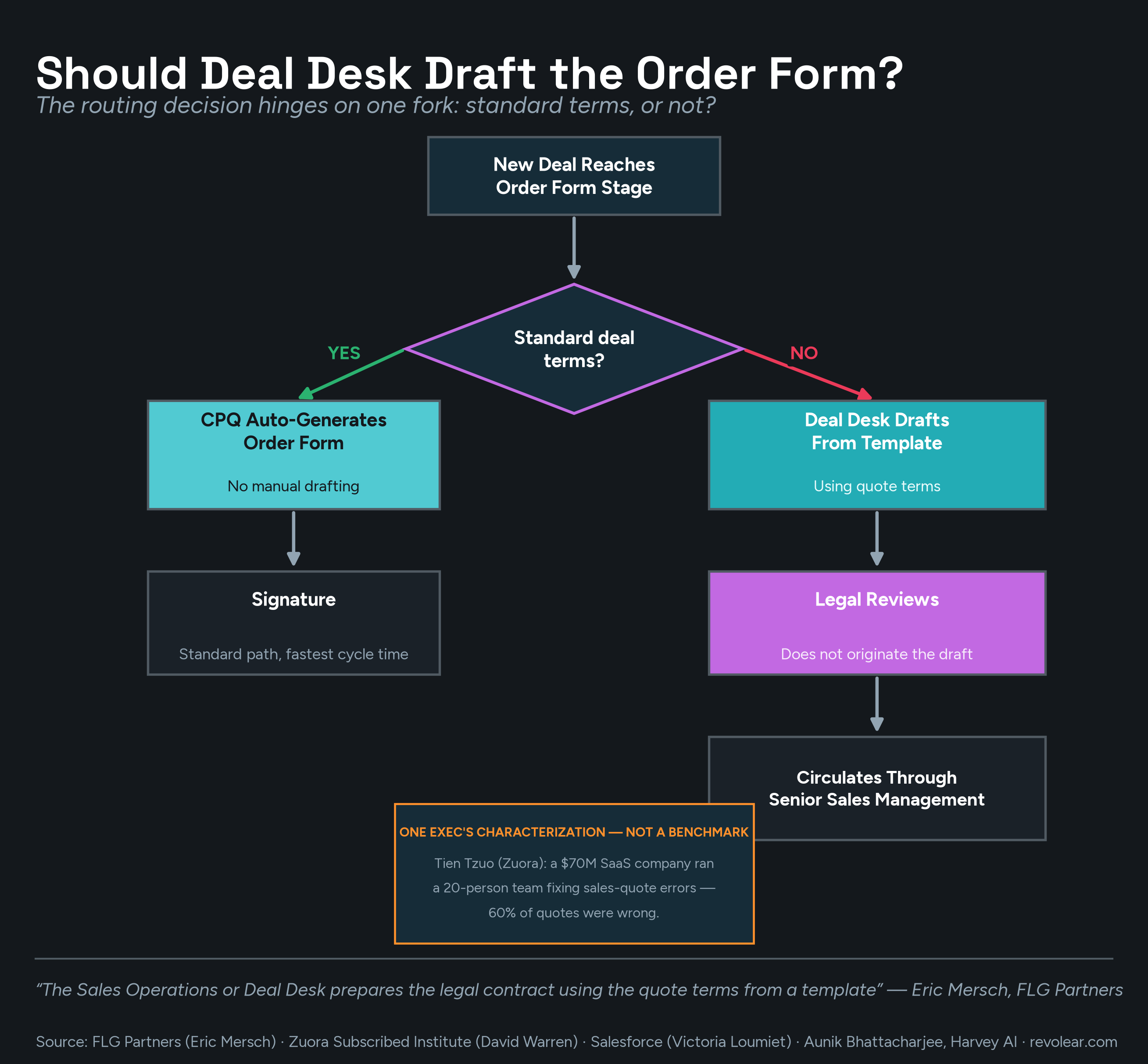
The cost of getting this wrong is illustrated, if not statistically proven, by an anecdote from Tien Tzuo, Founder and CEO of Zuora: he describes lunch with the CFO of a $70M SaaS company who told him, "We have a 20-person team in accounting whose only job is fixing errors in cleaning up sales quotes" — "60% of those quotes were wrong." Treat this as one named executive's characterization of an unnamed peer's business, not a representative benchmark, but it is a vivid illustration of what happens when order-form preparation has no single owner (Tien Tzuo, Zuora).
The three variants below describe alternative structures for the same governance question — who prepares the order form before it reaches the customer — not three different processes.
Preferred: CPQ-Generated for Standard Deals, Deal Desk-Drafted for Everything Else
Order forms for standard deals — those within approved pricing, term, and structure guardrails — are generated automatically by [CPQ system] once the quote is finalized and require no manual drafting. Order forms for any deal outside those guardrails are prepared by [Deal Desk] directly from the approved quote terms, using the current contract template. [Deal Desk] circulates the draft to [Sales leadership] and [Legal] for review before the document is sent to the customer; Legal's review is limited to confirming no non-standard legal-risk language has been introduced outside of what was already approved.
Use this when: the company has CPQ infrastructure in place and enough deal volume to justify a clear standard/non-standard split — the model FLG Partners' Mersch describes as the norm for enterprise SaaS quote-to-cash.
Fallback: Deal Desk Drafts All Non-Trivial Order Forms Manually
[Deal Desk] prepares every order form from the approved quote terms using the current contract template, regardless of deal size, until [CPQ system] is implemented or configured to automate standard-deal generation. [Legal] reviews any order form that deviates from the standard template before it is sent to the customer.
Use this when: CPQ automation isn't yet in place — consistent with Zuora's account of deal desk's traditional, pre-automation role generating order forms by hand.
Approval-Required: Legal Drafts or Reviews Every Order Form
Every order form, regardless of deal size or structure, is drafted or reviewed in full by [Legal] before it may be sent to the customer. [Deal Desk] provides the approved quote terms as input but does not independently finalize contract language.
Use this when: the company has no deal desk function yet, or has not yet built a template library Legal trusts enough to delegate standard-language drafting — a reasonable temporary state, but not one any of the sources above describe as the long-term target.
One nuance worth separating out: who drafts the order form is a different question from who owns the CPQ platform. Mersch is explicit that "while the CPQ process is managed by the Chief Revenue Officer... I recommend that Chief Financial Officers understand the process in depth" (FLG Partners) — meaning deal desk typically drafts and works within CPQ, while the CRO's organization owns the platform's rules and configuration.
Revolear sets up dozens of new Order Forms every quarter for usage-based businesses and assists our customers' sellers in the mechanics of setting up these deals. The Preferred structure above — CPQ for standard deals, deal desk drafting for everything else — is the operating model we see win out as usage-based companies scale past their first few hundred customers.
Order-form drafting isn't a legal task that got outsourced to deal desk, and it isn't a sales task that got centralized either — it's a templated commercial task that deal desk is positioned to own precisely because it already holds the approved quote terms. The dividing line that actually holds up across sources is deal complexity, not deal size: standard deals should never need a human to draft anything, and non-standard deals should never reach the customer without deal desk's eyes on the language first.
Related in this series: this post is part of Revolear's Deal Desk Handbook. Read more from the series:
What a Deal Desk Actually Does (and Why Most Companies Eventually Build One) — read the pillar post
What Should Deal Desk Own vs. Route to Legal?
The Deal Desk Glossary — read the capstone

Explore our demos, discover our technology, get a quote, and meet our team—human and AI—in our Virtual Briefing Center.
548 Market St, Suite 69725
San Francisco, CA 94104.

