

Experience Revolear
Explore our demos, discover our technology, get a quote, and meet our team—human and AI—in our Virtual Briefing Center.

The Problem. "Strategic value" is the phrase that gets a below-standard deal past deal desk — and it's also the phrase with no agreed definition.
The Instinct That's Wrong. Treating qualitative factors like reference-ability, competitive displacement, and expansion potential as a narrative override that excuses whatever discount the rep is asking for.
The Fix. Convert every qualitative factor into a scored, gradable input with a defensibility test and a tracked obligation — so "strategic" becomes a falsifiable claim instead of an escape hatch.
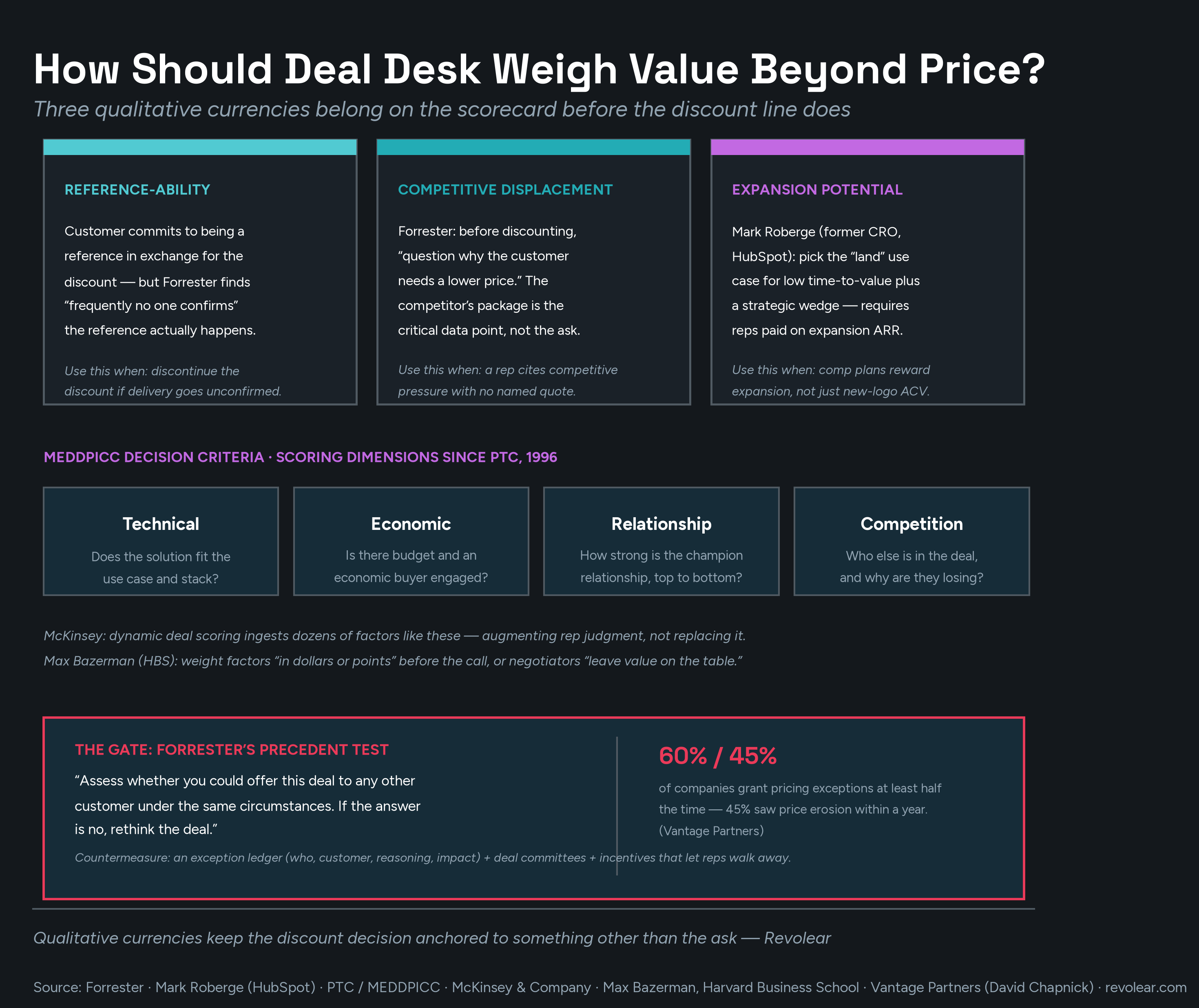
Deal desks that stop at price miss the reason strategic deals get approved in the first place. Forrester's maturity research on deal management makes this explicit: desks that operate as pure compliance checkpoints "often resulted in missing strategic value," while the mature version has "found a new niche — helping sales improve strategic deal positioning, win rates and deal velocity" (Forrester). The question isn't whether qualitative value belongs in the decision — it clearly does. The question is how to weigh it without turning it into cover for undisciplined discounting.
Three qualitative factors show up repeatedly in the evidence as legitimate trade value, provided they're tracked. Reference-ability is the clearest: Forrester notes that "customers can make commitments in return for special pricing and terms and conditions, such as agreeing to act as a reference in exchange for discounts" — but adds the crucial guardrail, that "frequently no one confirms that the customer delivered on the commitment," in which case "discounts should be discontinued" (Forrester). Competitive displacement is the second: Forrester's checklist for evaluating heavily discounted deals instructs the desk to "question why the customer needs a lower price," since a competitor's more attractive package is "critical" competitive-analysis data (Forrester). Expansion potential is the third, and it's the most relevant to a usage-based business: Mark Roberge, HubSpot's founding CRO, describes selecting a "land" use case specifically for "low time and effort to retainable value" and a "strategic wedge for further platform adoption" — but only when sellers are compensated more on expansion ARR than opening ACV, "so the expansion comes easy" (Mark Roberge, former CRO, HubSpot).
The mechanism that keeps these currencies honest is scoring them the same way you'd score any other deal input. MEDDPICC — the enterprise sales qualification framework that traces to PTC in 1996 — formalizes exactly this with its Decision Criteria element, which breaks non-price value into three explicit dimensions: Technical ("does your solution technically meet the requirements"), Economic ("finance, risk and efficiency"), and Relationship ("how closely do the values and direction of the two organizations align"), plus a dedicated Competition field in the extended framework (MEDDICC). Harvard Business School's Max Bazerman supplies the academic case for doing this in advance rather than in the room: "the next step is to determine their relative importance," typically with "a score sheet that weights each according to its importance… in dollars or points," because negotiators who improvise trade-offs on the spot "are likely to leave value on the table" (Harvard Business Review).
McKinsey's "dynamic deal scoring" is the operational version of the same idea at the deal desk level — a system that ingests "dozens of factors, from industry vertical to salesperson tenure and the product features each customer values most," runs them through analytics to determine which actually merit a discount, and flags "which deals could destroy value, helping managers determine whether to change the terms or walk away." Critically, McKinsey frames this as augmentation, not replacement: the scoring tools "aren't meant to replace the judgment or wisdom of the sales rep" (McKinsey & Company).
The evidence for why this discipline matters is uncomfortable. Vantage Partners' Pricing Exceptions study — led by partner David Chapnick — found that nearly 60% of companies grant pricing exceptions at least half the time, a quarter grant them almost always, and 45% of companies that grant exceptions saw their average selling price decline within a year of doing so (Vantage Partners). "Strategic" is precisely the label that makes an exception feel principled instead of undisciplined, which is why Vantage's countermeasure is procedural, not rhetorical: track every exception — who granted it, for which customer, the stated reasoning, and its measured impact — build deal committees to stop exceptions from resetting the norm, and structure incentives so reps can actually walk away from a bad deal rather than close it and move on (Vantage Partners).
Forrester's precedent test is the sharpest single filter for whether a qualitative justification is real: "assess whether you could offer this deal to any other customer under the same circumstances. If the answer is no, rethink the deal" (Forrester). If a "strategic" rationale can't survive being generalized into a rule, it isn't a rule — it's a favor.
Revolear sets up dozens of new Order Forms every quarter for usage-based businesses and assists our customers' sellers in the mechanics of setting up these deals. The exception ledger is almost always the missing piece — teams can usually articulate why a deal is strategic in the moment, but few can show, six months later, whether the reference actually referenced or the expansion actually expanded.
Qualitative value is real, but it only survives deal desk scrutiny when it's scored on a shared rubric, tested against the precedent question, and tracked as an obligation rather than a narrative. The desks that get this right don't say no to strategic deals — they make "strategic" prove itself.
Related in this series: this post is part of Revolear's Deal Desk Handbook. Read more from the series:
Building a Discount Approval Matrix: The Authority-Tiering Framework — read the post
Should Deal Desk Coach Sales Managers, Not Just Approve Deals? — read the post
The Deal Desk Glossary — read the capstone

Explore our demos, discover our technology, get a quote, and meet our team—human and AI—in our Virtual Briefing Center.
548 Market St, Suite 69725
San Francisco, CA 94104.

