

Experience Revolear
Explore our demos, discover our technology, get a quote, and meet our team—human and AI—in our Virtual Briefing Center.

Plot discount depth against deal size at almost any company before it has a real approval structure, and you get a scatterplot with no relationship at all — a $50,000 deal and a $500,000 deal discounted at roughly the same rate because whoever approved them had no shared frame of reference. The fix is not simply "more approval." Research on delegated pricing authority finds that over-centralizing decisions is nearly as costly as under-controlling them. The fix is a defined authority ladder — a small number of clear tiers that tell a rep, in advance, exactly how much discount they can grant themselves before anyone else needs to get involved.
The Problem. Without a defined authority structure, discount approval swings between two failure modes: a free-for-all where every rep sets their own price, or a bottleneck where every request waits on one executive.
The Instinct That's Wrong. Assuming that routing more requests to more senior approvers automatically produces more pricing discipline.
The Fix. A tiered authority ladder — the same "good, better, best" structure a twelve-year Salesforce deal desk veteran built from scratch — that lets reps resolve low-risk discounts themselves and escalates only the requests that actually carry risk.

Todd Johns, who built and ran deal desk at Salesforce for twelve years, described the logic in a recent conversation with Revolear: "I always formulated this as a pyramid: what are the flavors of a given term, and where does each one fall on the risk spectrum? That lets you arm sales to handle the low-risk version on their own... It's fundamentally about velocity: sales shouldn't have to go back and forth repeatedly if they already know their guardrails" (Todd Johns, in conversation with Revolear).
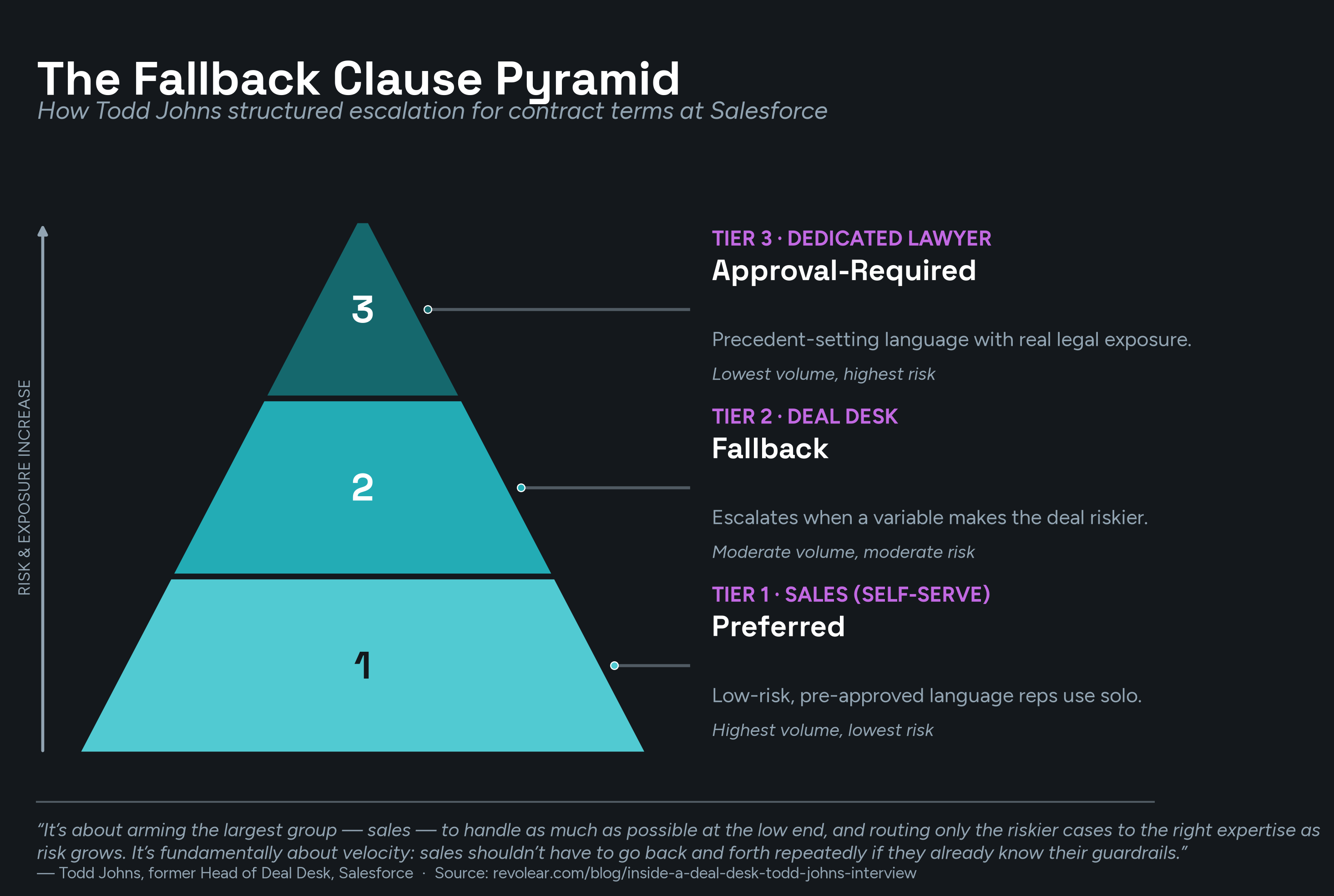
The three variants below are alternative structures for the same policy slot in a deal desk charter or sales approval policy, not three different policies — drop-in-ready language sized for a company running roughly $100K-ACV deals.
Preferred: The Three-Tier Pyramid
Discount requests within the standard band defined by [Deal Desk / RevOps] require no additional approval beyond the Account Executive's own quote. Requests that exceed the standard band, or that introduce a non-standard structural term, route automatically to [Deal Desk] for review and are resolved within [__] business hours. Requests that are precedent-setting, that fall below the defined price floor by more than [__]%, or that carry material multi-year revenue exposure escalate to [named Sales or Finance executive] for final sign-off. [Deal Desk] reviews and resets each tier's thresholds on a [quarterly] cadence against realized pricing data.
Use this when: deal volume and pricing history are large enough to set data-backed thresholds — the model Todd Johns described building at Salesforce, and the structure BCG's "solution space" and Bain's "escalating system of approvals" both describe in the abstract.
Fallback: The Two-Tier Compressed Model
Discount requests up to [__]% require no additional approval beyond the Account Executive's own quote. Requests above [__]% require review and written sign-off from [a single designated Deal Desk approver or Sales leader] before the quote may be issued to the customer. This structure remains in place until deal volume or the frequency of non-standard-term requests justifies adding a third, executive-level tier.
Use this when: a company is early-stage and does not yet have the deal volume to justify a distinct executive tier. Monitor it closely — Simon-Kucher's finding that discounts peak at escalation limits applies most acutely to a single hard threshold, since every rep has a clear incentive to land just under it.
Approval-Required: Centralized Sign-Off
All discount requests, regardless of size, require review and written approval from [CRO / CFO] before a quote may be issued to the customer. This structure applies only during an initial pricing period, a new market or product launch with no established pricing precedent, or following a governance failure requiring temporary centralization, and converts to a Preferred or Fallback structure within [__] days once sufficient deal data exists to set defensible thresholds.
Use this when: the company genuinely lacks the pricing history to set any threshold with confidence — but treat it as temporary. The Journal of Marketing's inverted-U finding is the clearest evidence that leaving this structure in place indefinitely costs as much in profitability as no controls at all.
Revolear sets up dozens of new Order Forms every quarter for usage-based businesses and assists our customers' sellers in the mechanics of setting up these deals. The authority ladder above is the single most common structural gap we find when a growing company first asks us to help formalize its deal desk.
A discount approval matrix is not about adding more layers of scrutiny — it is about putting the right decisions at the right altitude. Reps handle what they can see clearly; deal desk handles what needs a second set of eyes; a named executive handles what sets precedent. Get that balance wrong in either direction, and the research says you pay for it in the same currency: lost margin, in either a shotgun-pattern scatter of undisciplined discounts or a queue of deals stuck waiting on one overloaded approver.
Related in this series: this post is part of Revolear's Deal Desk Handbook. Read more from the series:
What a Deal Desk Actually Does (and Why Most Companies Eventually Build One) — read the pillar post
Inside a Deal Desk: A Conversation With Todd Johns, Former Head of Deal Desk at Salesforce — read the interview
What Should Deal Desk Own vs. Route to Legal?
Should Deal Desk Coach Sales Managers, Not Just Approve Deals? — read the post
How Deal Desk Weighs Qualitative Factors Beyond Price — read the post
The Deal Desk Glossary — read the capstone

Explore our demos, discover our technology, get a quote, and meet our team—human and AI—in our Virtual Briefing Center.
548 Market St, Suite 69725
San Francisco, CA 94104.

